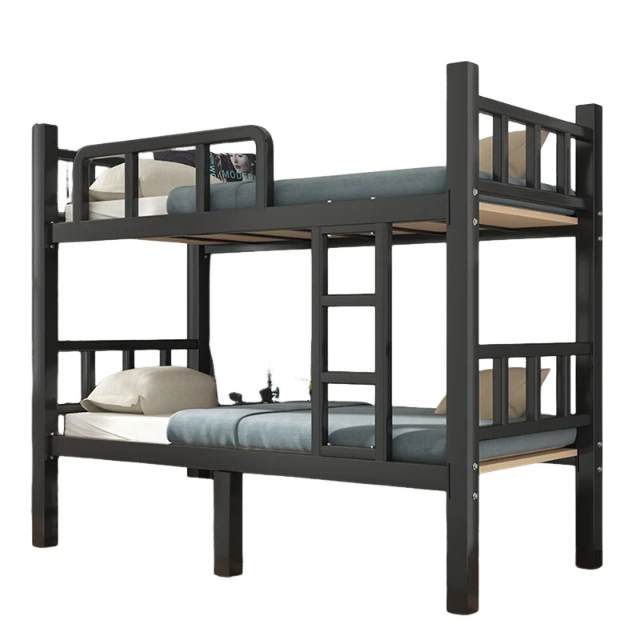
Technical standards for dormitory beds are primarily designed to ensure safety, comfort, and durability. Regarding load-bearing capacity and structural integrity, each bed is generally required to support 150 to 200 kilograms; the structure must be stable, with all connectors securely fastened. Bunk beds must be equipped with guardrails and sturdy ladders; guardrails on the upper bunk generally require a height of at least 30 centimeters, while ladders must feature evenly spaced, non-slip rungs to ensure safe access.
In terms of materials and durability, metal bed frames are typically constructed from steel tubing or wrought iron with wall thicknesses ranging from 1.2 to 2 millimeters, finished with powder coating or baked enamel to prevent corrosion. Wooden or composite bed platforms must be dry and flat, free from cracks or warping, and made from eco-friendly, non-toxic materials to safeguard student health and ensure comfort.
Regarding safety and protection, bed corners must be rounded to prevent injuries from bumps. The space beneath the bed must be free of gaps that could trap fingers or toes, and components such as guardrails, ladders, and support bars on bunk beds must pass compression and bending tests to guarantee stability and safety during long-term use. These technical standards provide a reliable foundation for the safety, comfort, and durability of dormitory beds.